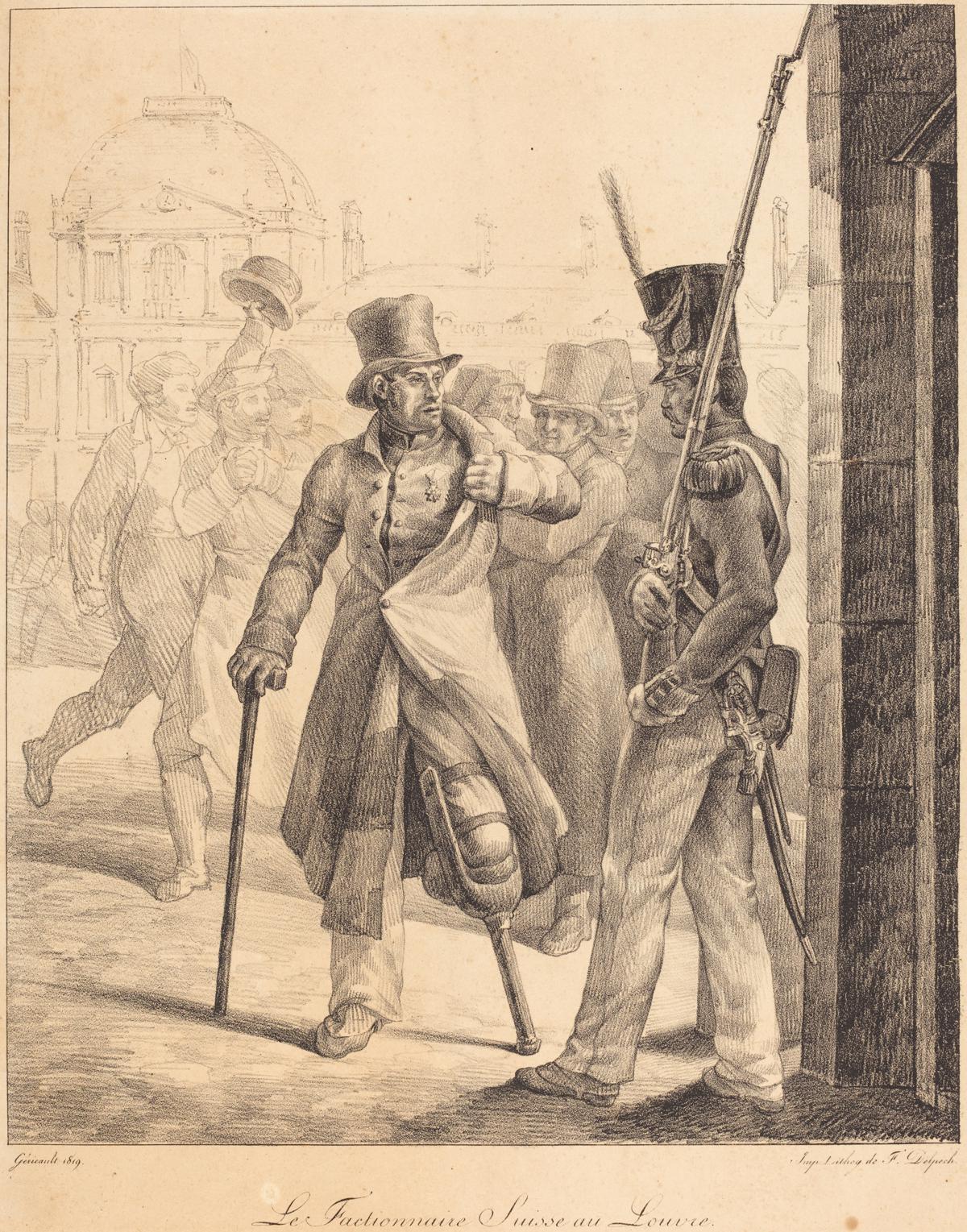

The Swiss Sentry at the Louvre (Le factionnaire Suisse au Louvre)
1818 - PrintMy name is Feely T. Heart, and I will be your guide today through one of our paintings: nn Today, we are looking at "The Swiss Sentry at the Louvre (Le factionnaire Suisse au Louvre)" by Théodore Géricault. Created in 1818, this striking print captures a seemingly mundane moment in time, yet it speaks volumes about power, authority, and the human experience. nn Notice the stark contrast between the Swiss Sentry, standing rigidly in his crisp military uniform, and the one-legged man addressing him. The soldier, a symbol of military might, occupies a significant portion of the composition, while the civilian, leaning on his cane, appears almost dwarfed by his presence. Géricault masterfully uses light and shadow to further emphasize this divide, bathing the soldier in light while the others fade into the background. nn Géricault, known for his powerful depictions of human and animal forms, captures the textures of the soldier's uniform and the play of light on his bearskin hat with incredible detail. The artist's masterful use of line and form brings a sense of immediacy to the scene, making us feel as if we are witnessing this interaction firsthand. nn This artwork, part of the esteemed Rosenwald Collection, offers a glimpse into the social dynamics of post-revolutionary France. The presence of Swiss mercenaries guarding a cultural institution like the Louvre speaks to the political climate of the time. nn Through his masterful technique and keen observation of human interaction, Géricault elevates a simple encounter into a powerful commentary on the complexities of power and the human condition.
Creator
Collection

FeelTheArt®
Want to see more ? Try the app now !

or